The 4-3-3 Is a Starting Picture, Not a Fixed Shape
Read the 4-3-3 formation beyond its lineup graphic: track changing player roles, team shape in possession and defense, and the clues after turnovers.
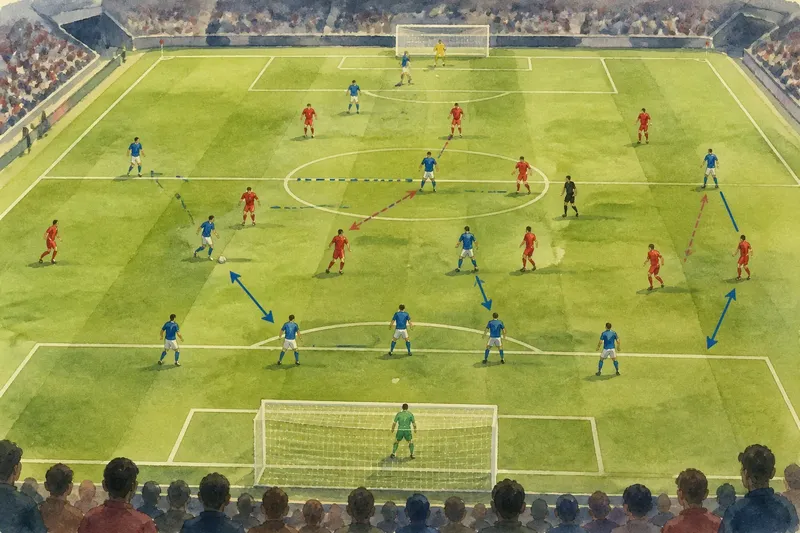
At kickoff, the broadcast graphic places four defenders, three midfielders, and three forwards in neat rows. A few passes later, one midfielder has dropped beside the center backs, a winger is holding the touchline, and the opposite fullback has advanced. The 4-3-3 formation is still the team’s nominal arrangement, but the picture on the field has already changed.
To read the shape well, treat the numbers as a starting point rather than a description of every moment. Watch how players relate to one another in possession, while defending, and just after the ball changes hands.
The 4-3-3 formation names the starting lines
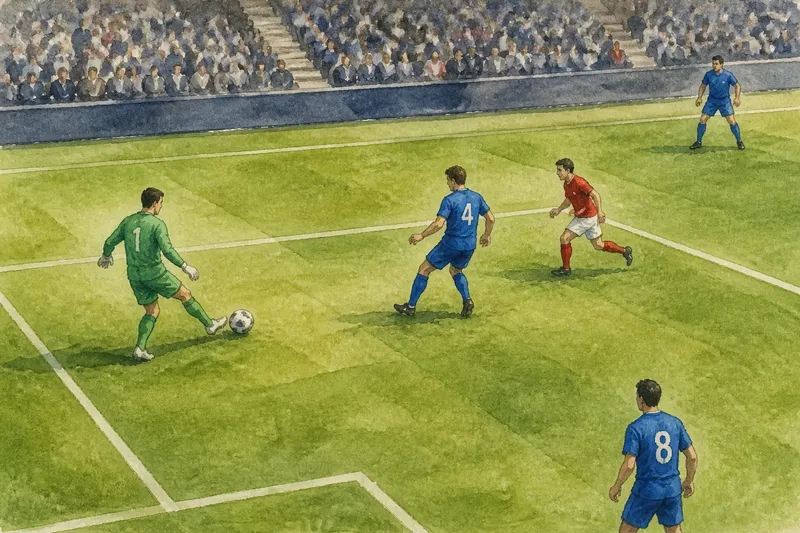
In a 4-3-3, the first number usually refers to four defenders, the second to three midfielders, and the third to three forwards. The count gives a quick sense of a team’s broad arrangement, often clearest at a goal kick or kickoff.
It does not tell you where every player will stand throughout the match. A midfield three might include one player deeper than the others, or three players at similar heights. The front line may have a central striker between two wingers, but those forwards can switch sides, drift inside, or drop toward the ball.
Television graphics simplify the lineup; they are not live tracking maps. Instead of asking where the midfielders are supposed to stay, notice what jobs they are doing and how their teammates respond.
Possession stretches the shape in different directions
With the ball, players spread out to create passing routes and make the defending side cover more ground. A winger may stay near the sideline to hold an opposing fullback wide. A central forward can occupy the center backs while a midfielder moves toward the ball to connect defense and attack.
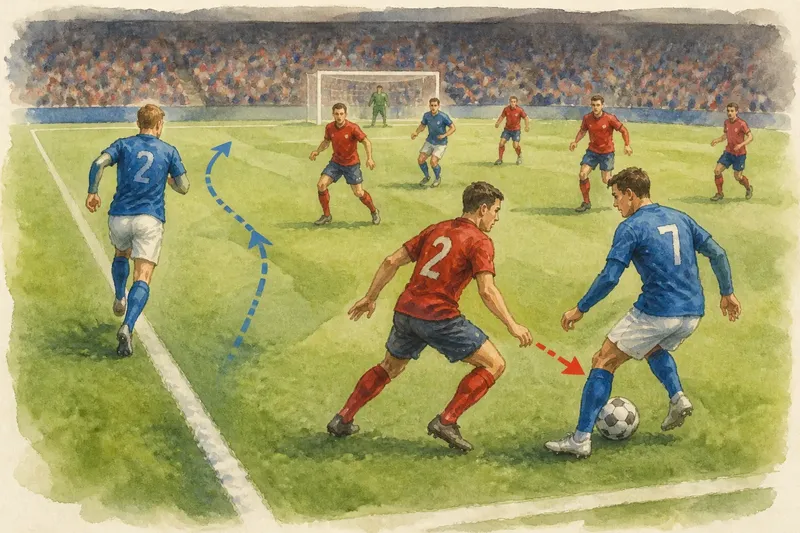
The fullbacks’ positions also change the picture. One might advance outside the winger while the other stays closer to the center backs. If both push high, several players may be ahead of the ball, leaving a smaller group behind it. If one holds back, the rear line can look more like three defenders while the other side provides width.
An uneven shape is not necessarily a sign that the plan has broken down. A team may give each side a different job. Notice who provides width, who occupies the middle, and how many teammates remain behind the ball as attacks develop.
The midfield three can make different triangles
The label “three midfielders” tells you how many players are assigned to the line, not how they relate to one another. One common arrangement has a deeper midfielder in front of the center backs and two teammates playing higher. From above, the trio looks like a triangle with its point toward the defense.
In another arrangement, two midfielders stay closer to the back line and one plays ahead of them. That triangle points toward the forwards. The difference affects who can receive the first pass, who can support the striker, and which spaces the team can protect after losing possession.
The triangle can tilt as the ball moves. If possession is on the left, one midfielder may shift across to help while the far-side midfielder holds a more advanced position or moves into an open lane. Track who stays behind the ball, who offers a forward option, and who moves toward the attack rather than trying to memorize a fixed diagram.
The forwards help determine the defensive shape
Without the ball, the front three can press high, retreat toward midfield, or adjust their positions to guide the opponent’s passing. If the center forward moves toward a center back, the wingers may angle inward to discourage passes through the middle. If the team drops deeper, those wingers can fall back and help protect the wide areas.
As the forwards retreat, the lines behind them may tighten. The midfielders can move closer together, and the defense can step up or drop back according to the ball and the space behind the line. The team may then resemble a 4-5-1, even though it started with three forwards and may return to that arrangement after winning possession.
One snapshot can mislead. A winger briefly near the midfield line does not by itself prove that the team has changed formation. Watch several passes: do the wide forwards regularly recover into the midfield line, or are they reacting to one moment? Repeated movement offers a clearer clue than a single frame.
Transitions show how players cover exposed space
A transition begins when possession changes. The first movements can reveal a team’s priorities: nearby players may close down the ball while others recover toward protective positions or run into space for a counterattack.
These reactions can make the familiar lines hard to recognize. A midfielder who had been beside the striker may sprint back between the lines. A fullback caught high may recover toward the center while a center back shifts across to cover. The movement shows how the team manages exposed space, not simply which formation it uses.
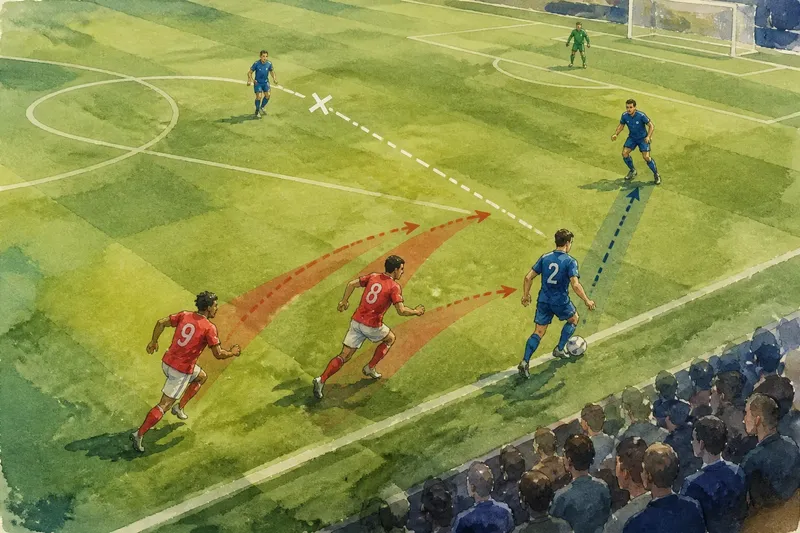
Imagine a team attacking down its right side when an opponent intercepts a pass. The nearest winger turns to pressure the ball, a midfielder runs back to screen the central route, and the far-side fullback tucks inward. The expected observable result is a compact group forming behind the pressure, even though the lineup graphic still says 4-3-3.
If the team wins the ball instead, look for its first forward option. A winger may run into the channel, the striker may hold a central position, and a midfielder may support behind them. The counterattack’s direction and order of movement are useful clues, even when its outcome is uncertain.
Match questions clarify what the formation graphic cannot show?
Does a 4-3-3 stay the same throughout a match?
No. It describes a starting arrangement, while possession, defending, and transitions pull players into different positions. The same team can resemble several shapes without changing its nominal formation.
Why does a 4-3-3 sometimes look like a 4-5-1?
The wide forwards may retreat into the midfield line to help defend, leaving the center forward highest. If this happens repeatedly, it is a clue about the defensive plan, not proof that the original lineup label was wrong.
How can I tell which midfielder is playing deepest?
Watch who most often offers a short pass in front of the center backs and who stays behind the ball as teammates advance. Compare several possessions, since one run can briefly distort the picture.
What should I watch after possession changes?
Follow the nearest players and the teammates behind them. Their first movements show whether the team is pressuring the ball, protecting central space, or making an immediate forward run.
A few observations make the shape easier to read
Use these checks while watching a match. Each one links a visible clue to a decision about what to watch next.
Check where the wide forwards stand when the team defends. If both repeatedly drop beside the midfielders, read the shape as a more compact defensive block; if they stay high, watch how the midfield covers the wide spaces they leave.
Check which midfielder stays behind the ball as teammates advance. If one player regularly offers a short pass in front of the center backs, treat that player as the deeper link; if no one holds that position, watch how the team protects the space in front of its defense.
Check which players provide width in possession. If a winger stays near the sideline, look for an inside route from a teammate; if the winger moves inward, see whether a fullback advances to occupy the outside lane.
Check whether both fullbacks advance together. If they do, note how many players remain behind the ball and watch for a teammate covering centrally; if only one advances, compare the opposite side for a more cautious role.
Check how the midfield shifts when the ball moves to one flank. If the trio slides toward the ball, look for the far-side midfielder guarding an open lane; if the far-side player stays high, watch whether the defense adjusts to protect the space behind.
Check the first movements after a turnover. If nearby players press the ball and teammates retreat behind them, read it as an attempt to contain the transition; if a forward immediately runs into space, watch whether a teammate can find that outlet.
For a worked example, imagine a team listed in a 4-3-3 with one deeper midfielder and two higher ones. It attacks down the right, with the right winger wide and both fullbacks advanced. The opponent intercepts a pass: the right winger presses, the deeper midfielder retreats toward the center backs, and the far-side fullback tucks inward. The observable result is a compact group around and behind the ball, with the team’s original attacking lines no longer visible. If the opposing player escapes the pressure, the exposed space behind the advanced fullbacks becomes the next area to watch.
The 4-3-3 formation is a clue, not a verdict
The 4-3-3 formation gives you a useful first picture: four defenders, three midfielders, and three forwards. Its limits become clear as players exchange positions, adjust to the ball, and respond to a change of possession.
Track one relationship at a time: the midfield triangle, the forwards’ defensive work, or the players staying behind an attack. The formation label can orient you, while movement explains what the team is trying to do. When the next phase begins, check whether the same players keep those jobs or trade them; that distinction helps separate a recurring team pattern from a brief response to the ball.