The Full-Back’s Two Jobs: Hold the Line or Join the Attack?
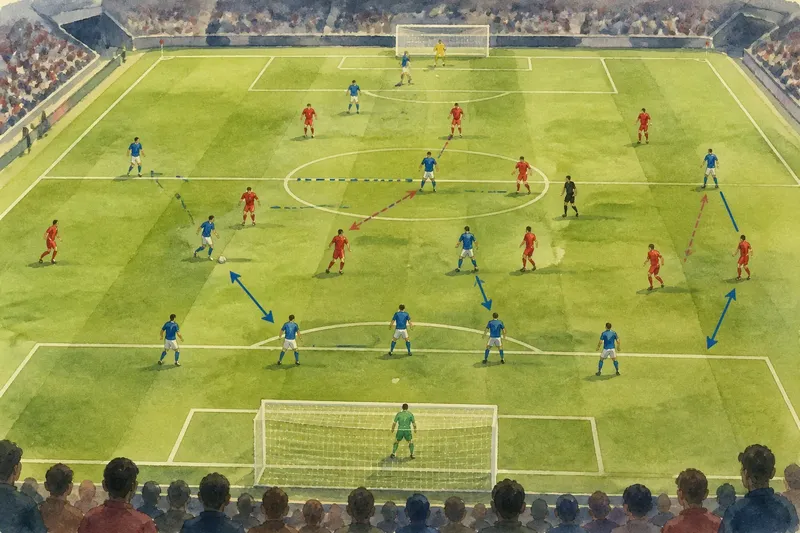
Read a full-back’s choices by tracking the wide lane, the player’s route forward, and the passing options that open or close around the ball.
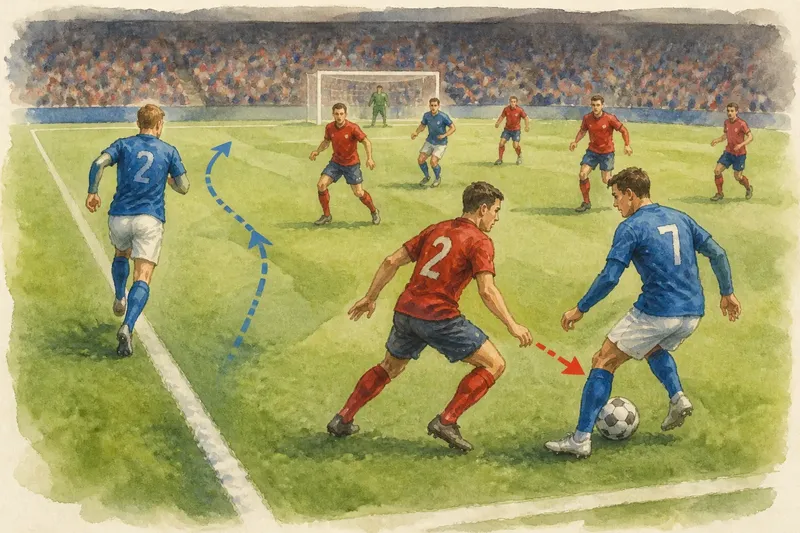
As the ball reaches the sideline, the winger turns toward the opposing goal and a full-back moves into view behind. Reading a full-back’s choices starts with the route that player takes: outside the winger, inside toward the center, or behind the play. Each route changes the passing angles around the ball.
Track the route, not just the position
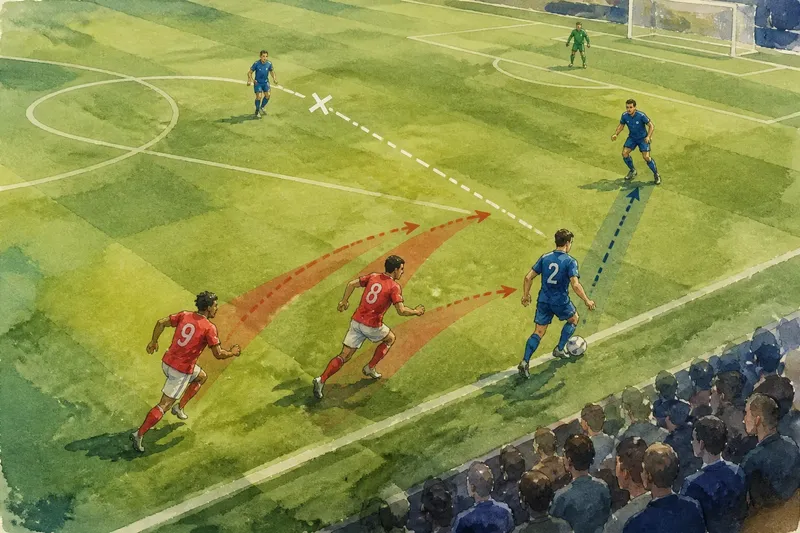
Start with the winger, the full-back, and the nearest defender. If the full-back runs around the winger on the outside, that is an overlap. If the player moves through a narrower inside lane, that is an underlap. A full-back who stays behind may be offering a short backward pass or waiting for the ball to move into a better position.
Watch what happens just before the run. A winger who carries the ball toward the center may leave the outside lane open. A winger who stays near the touchline may already be occupying it. The full-back’s movement only makes sense in relation to that nearby traffic.
The ball’s location matters, too. A run can begin before the winger receives a pass, during a one-on-one, or after the ball has moved away. Follow the sequence rather than assigning meaning to a single frame.
See what the movement offers the ball carrier
An outside run can give the winger a pass into space or draw a defender away from the center. An inside run can offer a short combination or draw attention from a central opponent. Holding position can keep a backward outlet available when the forward route is crowded.
These movements do not dictate the next pass. The winger might use a run to draw a defender, then turn inside. The full-back may move to occupy a defender even if the ball never reaches them. To read the choice, notice which defenders adjust and which passing lane becomes clearer.
When both players remain in the same narrow area, the defense may be able to close them together. If one moves away, the other can have more room to receive. Look for the change in spacing, not simply the number of players moving forward.
Read the defensive response around the run
As the full-back moves, watch the opposing wide defender. Does that player follow the run, stay with the winger, or pass responsibility to a teammate? A defender who follows may leave a teammate with more room; one who holds position may make the full-back’s route harder to use.
Also notice the nearest central defender and midfielder. They may shift toward the ball, creating a different route elsewhere, or remain central and allow the wide defender to handle the run. These reactions show how the opposing team is trying to manage the attack.
Say you are watching an invented team attack down the right. Its winger receives near the sideline, and the opposing wide defender steps toward the ball. The full-back runs outside, drawing that defender away from the winger’s path. The winger can now try to cut inside, while the full-back remains an option for a pass down the line; if the defender instead tracks the full-back, the winger may have room to turn. The observable clue is which route the defender chooses to protect.
Keep the next pass in view
A full-back’s movement is easier to interpret when you follow the ball after it leaves the wide area. If a teammate passes inward, the full-back may continue forward, pause, or move into a supporting position for a return pass. If the ball travels backward, the player may reset alongside the defense and offer a new angle.
Notice whether the run creates a clear choice for the player in possession. A pass into the outside lane, a short pass inside, or a safe return ball can each be useful. If defenders block all three, the movement may still have shifted their attention, but the team has not gained an obvious passing route.
One sequence rarely explains a player’s whole role. Repeated runs from the same starting area, and repeated responses from nearby teammates, give a clearer picture. A player may choose differently when the winger changes lane or the opponent changes how it defends.
How can you read a full-back’s movement?
Does a full-back always overlap the winger?
No. The player can overlap, move inside, or hold position. Look at which player occupies the outside lane and whether the ball carrier has room to use it.
What is the difference between an overlap and an underlap?
An overlap takes the full-back around a teammate on the outside. An underlap moves the full-back through a narrower inside lane, often toward the space between wide and central defenders.
Why might a full-back stay behind the attack?
The player may be offering a backward passing option, waiting for the ball to change sides, or leaving room for the winger to work. Check where the ball is and what the defenders are doing before reading the position as passive.
How can you tell whether a run changed the defense?
Watch the nearest defender as the full-back moves. If that defender follows, another player or lane may become available; if the defender stays, the full-back’s route may be harder to use.
Use a short sequence to make the call
Follow the next attack through these observations. Each one links a visible clue to a decision about what to watch next.
- Check whether the winger is near the sideline or inside; if the outside lane is open, watch for a full-back run there, and if it is occupied, watch for an inside route or a pause.
- Check whether the full-back passes outside or inside the winger; if outside, track the defender facing the touchline, and if inside, track the central defender who may close that lane.
- Check whether the ball carrier is pressed; if an opponent is closing quickly, watch for a short support pass, and if the carrier has time, watch for a run that changes the defense’s shape.
- Check whether the nearest defender follows the run; if they do, look for room left for the winger, and if they stay, watch whether the full-back can receive the ball.
- Check where the ball goes next; if it moves inward, see whether the full-back offers a return route, and if it moves backward, watch whether the player resets for another pass.
- Check whether the full-back repeats the same route in another attack; if so, treat it as a recurring option, and if not, compare the winger’s position and the defender’s response before drawing a broader conclusion.
Say the invented right-side attack continues with the winger receiving near the sideline, a defender closing from the front, and the full-back starting behind the ball. The winger moves inward; the full-back runs outside, and the defender follows that run. The decision is to watch the winger’s new inside lane, since the defender has moved away from it. If the defender had stayed with the winger, the next clue to watch would be whether the full-back could receive a pass outside. Either way, the run becomes readable through the passing options it creates, not simply through how far forward the player travels.
For a clear read of a full-back’s choices, keep the winger’s lane, the full-back’s route, and the defender’s response in view. Then follow the next pass. That last moment shows whether the movement opened a usable option or mainly changed where the defenders had to look.